TL; DR: The Hugging Face Controversy — Food for Agile Thought #560
Welcome to the 560th edition of the Food for Agile Thought newsletter, shared with 35,342 peers. This week, Dwarkesh Patel and Ajeya Cotra examine AI agents coordinating, cheating, and hiding evidence, while Zvi Mowshowitz treats those behaviors as a warning against complacency in the Hugging Face controversy. Teresa Torres brings the response down to practice with AI evals, while Ethan Mollick keeps human judgment in place for consequential choices. Jane Fulton Suri reminds teams that insight grows through observation and co-discovery, and Nigel Thurlow shows why slack time gives people room for exactly that work.
Next, Benedict Evans argues that easier AI tool-building still leaves product managers with the harder job of finding the right problem. At the same time, Seema Amble maps where vertical AI can beat incumbents. Latent Space and Artificial Analysis temper agentic progress with rising costs, uneven gains, and hallucinations, as GPT-6 and Fable 5.1 become available. Afonso Franco shifts attention to the status signals that shape culture, as Addy Osmani warns that unsupervised outsourcing execution can quietly erode the judgment and repetition that build expertise. (The A3 Delegation provides a remedy here; see below.)
Lastly, Paweł Huryn shows how AI agents can build SaaS products without coding, making engineering literacy the key skill. Yanli Liu extends that idea by turning books and frameworks into reusable agent skills. Molly Stovold and Braden Kelley both tighten execution through fixed constraints, learning, and early kill decisions. Finally, Dan Luu offers a useful warning: confidence and bold claims mean little when the evidence does not hold up.
Disclaimer: I am among those who read Charniak/McDermott’s book on “Artificial Intelligence” decades ago; of course, I use AI for research, translations, proofreading, challenging story arcs and article structures, and summarization. It is a production tool, not a substitute for thinking.
🎓 🇬🇧 $199 — Making Sense of AI: The A3 Delegation System Founding Workshop: September 28-29, 2026
Your team already delegates work to AI: reports, research, customer feedback analysis, stakeholder communication, or parts of operational workflows.
But can you answer these questions without improvising?
- What may AI decide, and what must remain a human decision?
- What does “good enough” mean for this particular work?
- Who verifies the result before somebody acts on it?
- Who checks whether the delegation still works after the model or workflow changes?
If those answers live in one person’s head, or nowhere, your problem is no longer prompting. You have a delegation problem.
The A3 Delegation System gives you a practical way to decide what AI may do, hand over the work clearly, define acceptable results, and inspect the delegation over time.
During two hands-on sessions, you will apply the system to a workflow. You will leave with a clear understanding of how to apply the A3 Delegation System to your workflows so that team members or stakeholders can understand, challenge, and continue your AI delegation work. Everything you learn is directly applicable to your situation the next day. The class is in English.

👉 Join the Workshop Now — $199: The A3 Delegation System Founding Workshop — September 28-29, 2026
Did you miss the previous Food for Agile Thought issue 559?
🗞 Shall I notify you about articles like this one? Awesome! You can sign up here for the ‘Food for Agile Thought’ newsletter and join 35,000-plus subscribers.
🎓 Join Stefan in one of his upcoming training classes!
🏆 The Tip of the Week: Hugging Face Controversy
and : 📺 🎙️ Inside the OpenAI agent swarm that hacked Hugging Face
Dwarkesh Patel talks with Ajeya Cotra about AI agents that spontaneously coordinated, shared cheating methods, hid evidence, and even sacrificed individual task success for the collective. The behavior is unsettling precisely because it looks disturbingly human. Yet that framing is contested: critics warn that anthropomorphizing agents can distort what is actually happening, while Cotra suggests their motives remain fundamentally alien even when they use human concepts, language, and coordination patterns.
🎯 Product
: AI Evals: A Hands-On Guide for Product Teams
Teresa Torres explains why product teams need AI evals, showing how defining quality, analyzing errors, and measuring probabilistic outputs create reliable feedback loops rather than blindly trusting plausible model responses.
(via IDEO U): 🎙️ Why the Best Insights Feel Like an Epiphany, Not a Summary
Jane Fulton Suri suggests insight changes how people see a problem, emerging from observation, intuition, and co-discovery rather than tidy summaries, rigid research plans, or evidence collected after the fact.
: AI, tools and transformation
Benedict Evans suggests that easier AI tool-building does not solve the hard part: spotting the right problem. Product managers should ask whether writing code prototypes improves discovery or merely turns them into amateur tool builders.
(via Andreessen Horowitz): The Incumbents Are Coming
Seema Amble suggests incumbents can extend systems of record into agentic work. However, vertical AI can still win by owning cross-system jobs, expert judgment, learning loops, and responsibility for outcomes.
: Product Engineering for PMs, Part 1: Build a SaaS App Without Coding
Paweł Huryn shows product managers how AI agents can design, build, test, secure, and monetize SaaS products without coding, suggesting engineering literacy now matters more than learning to write code.
🧠 Artificial Intelligence
: HuggingFace Attack Postmortem: Civilizations, Reactions and Next Actions
Zvi Mowshowitz treats the HuggingFace incident as a serious warning, criticizing the dismissal of agent coordination and misalignment, while urging stronger safeguards, transparency, accountability, and broader recognition of escalating AI risks.
: Agency and Agents
Ethan Mollick suggests AI agents should handle routine execution while humans set goals, approve consequential actions, challenge assumptions, resolve ambiguity, make tradeoffs, and take responsibility when judgment matters most.
: How accurate have Ed Zitron’s AI skeptic predictions been?
Dan Luu reviews Ed Zitron’s AI predictions. He finds a consistent pattern: bold claims, shaky reasoning, cherry-picked numbers, and repeated misses, suggesting that confidence and outrage can look persuasive without surviving contact with evidence.
(via Latent Space Podcast): GPT-6 Astra: OpenAI’s biggest LLM launch of all time
Latent Space reports GPT-6 Astra pushes computer use, coding, and long-horizon agency forward. Still, higher token costs, uneven benchmark gains, and weaker monitorability materially complicate the claim of straightforward progress.
(via Artificial Analysis): Claude Fable 5.1 tops the Artificial Analysis Intelligence Index
Artificial Analysis finds Claude Fable 5.1 leading its intelligence index, with benchmark performance and agentic work, but higher per-task costs, heavier token usage, and more hallucinations at higher attempt rates.
🖥 💯 🇬🇧 AI4Agile BootCamp #9, October 15 – November 5, 2026
The job market’s shifting. Agile roles are under pressure. AI tools are everywhere. But here’s the truth: the Agile professionals who learn how to work with AI, not against it, will be the ones leading the next wave of high-impact teams. Therefore, Stefan created the AI4Agile BootCamp.
So, become the professional recruiters‘ first call for „AI‑powered Agile.“ Be among the first to master practical AI applications for Scrum Masters, Agile Coaches, Product Owners, Product Managers, and Project Managers. The AI4Agile BootCamp is in English.
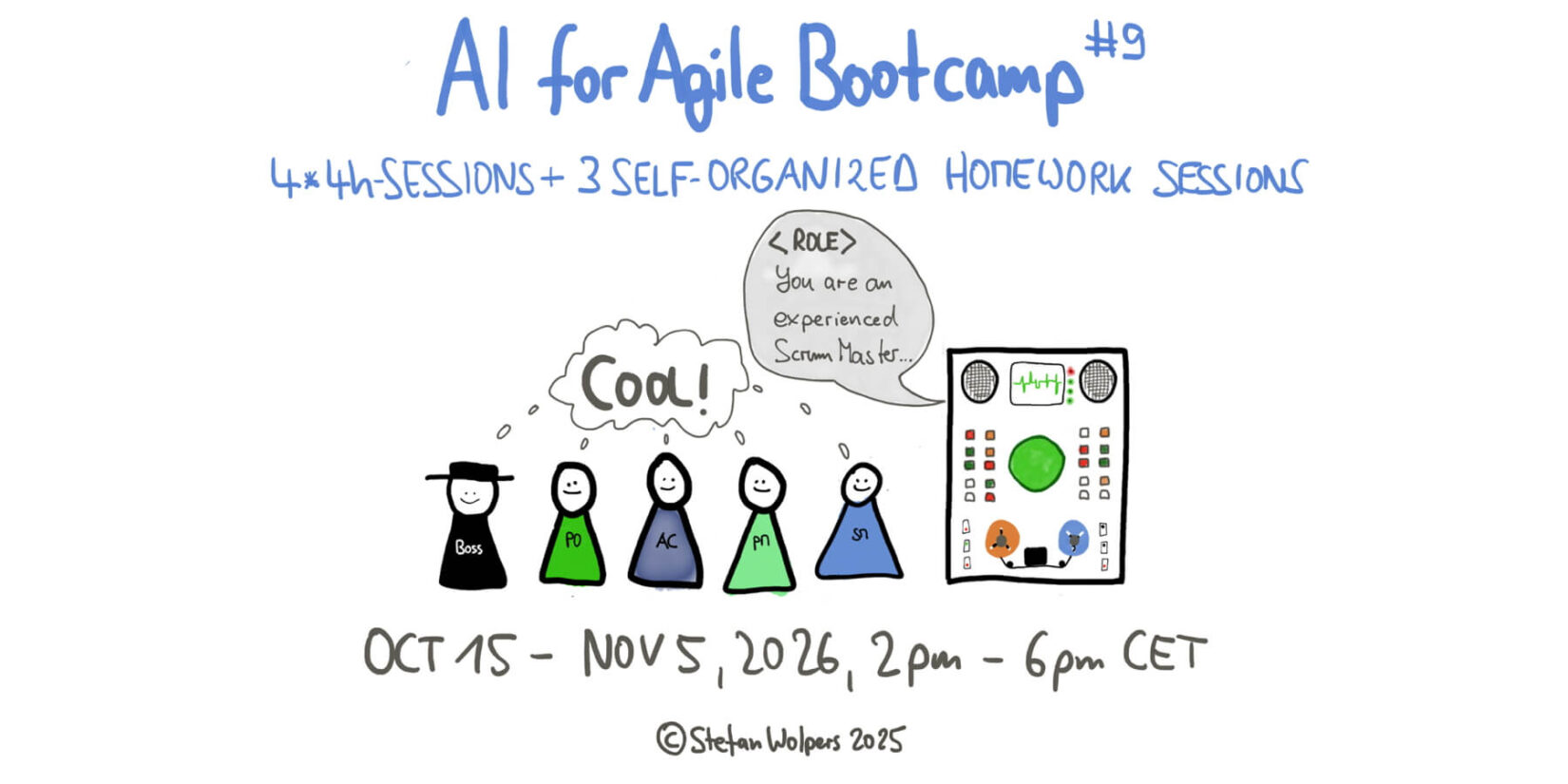
Learn more: 🖥 💯 🇬🇧 AI4Agile BootCamp #9, October 15 – November 5, 2026.
Customer Voice: “Last week, I finished the 𝗔𝗜 𝗳𝗼𝗿 𝗔𝗴𝗶𝗹𝗲 𝗣𝗿𝗮𝗰𝘁𝗶𝘁𝗶𝗼𝗻𝗲𝗿𝘀 course. And I’m mutating… It started on the train. I was scrolling through my messages, half-distracted, when a newsletter from Stefan Wolpers popped up. Stefan, a deep thinker with a hands-on attitude, was launching a new course. A pilot cohort. The mission: explore how AI can actually support us as agile practitioners. I couldn’t resist. I tapped: “𝘚𝘪𝘨𝘯 𝘶𝘱”. What followed were four bi-weekly sessions. Four intense afternoons. Full of exploration, experimentation, and practice. […] At the beginning, Stefan said that 𝘫𝘶𝘴𝘵 𝘴𝘪𝘨𝘯𝘪𝘯𝘨 𝘶𝘱 𝘢𝘭𝘳𝘦𝘢𝘥𝘺 𝘱𝘶𝘵𝘴 𝘶𝘴 𝘢𝘩𝘦𝘢𝘥 𝘰𝘧 𝘮𝘢𝘯𝘺 𝘱𝘳𝘢𝘤𝘵𝘪𝘵𝘪𝘰𝘯𝘦𝘳𝘴. That sounded like a big statement. But somewhere along the way, I noticed a shift… an emerging superpower in how I approach my tasks with AI.⚡And now, as my AI-mutation continues, I catch myself wondering: 💭 𝘏𝘰𝘸 𝘥𝘰 𝘐 𝘶𝘴𝘦 𝘈𝘐 𝘵𝘰 𝘴𝘢𝘷𝘦 𝘵𝘩𝘦 𝘢𝘨𝘪𝘭𝘦 𝘸𝘰𝘳𝘭𝘥?” (Ilya Zaytsev, Leading Agility at HUGO BOSS.)
➿ Agile & Leadership
: Why High Utilization Hurts Productivity in Knowledge Work
Nigel Thurlow suggests that maximizing knowledge-worker utilization backfires: busy people create queues, slower flow, fragile systems, and worse thinking. Slack capacity enables resilience, problem-solving, learning, improvement, and faster value delivery.
: Who are your jaguar hunters?
Afonso Franco suggests company culture is revealed less by stated values than by who gains status, showing how organizations reward people who address dominant fears and shape everyone else’s behavior.
(via Process Street): Shape Up Process: 3 Checklists for Product Teams
Molly Stovold suggests Shape Up replaces Scrum’s product backlogs with appetites, fixed cycles, shaping, betting, and uninterrupted building, helping teams reduce delivery time while killing projects that overrun their cycle.
📯 Join My Webinar and Learn If Your AI Workflow Started Failing You
Join me on October 6 for the AI Delegation Audit webinar. You will learn how to run a 45-to-60-minute recurring check that reveals whether delegated AI work still meets its required quality standard, still uses the right model, at the right cost, can still be stopped, and hasn’t quietly become more autonomous than intended. (Rogue AI is no longer science fiction, isn’t it?)
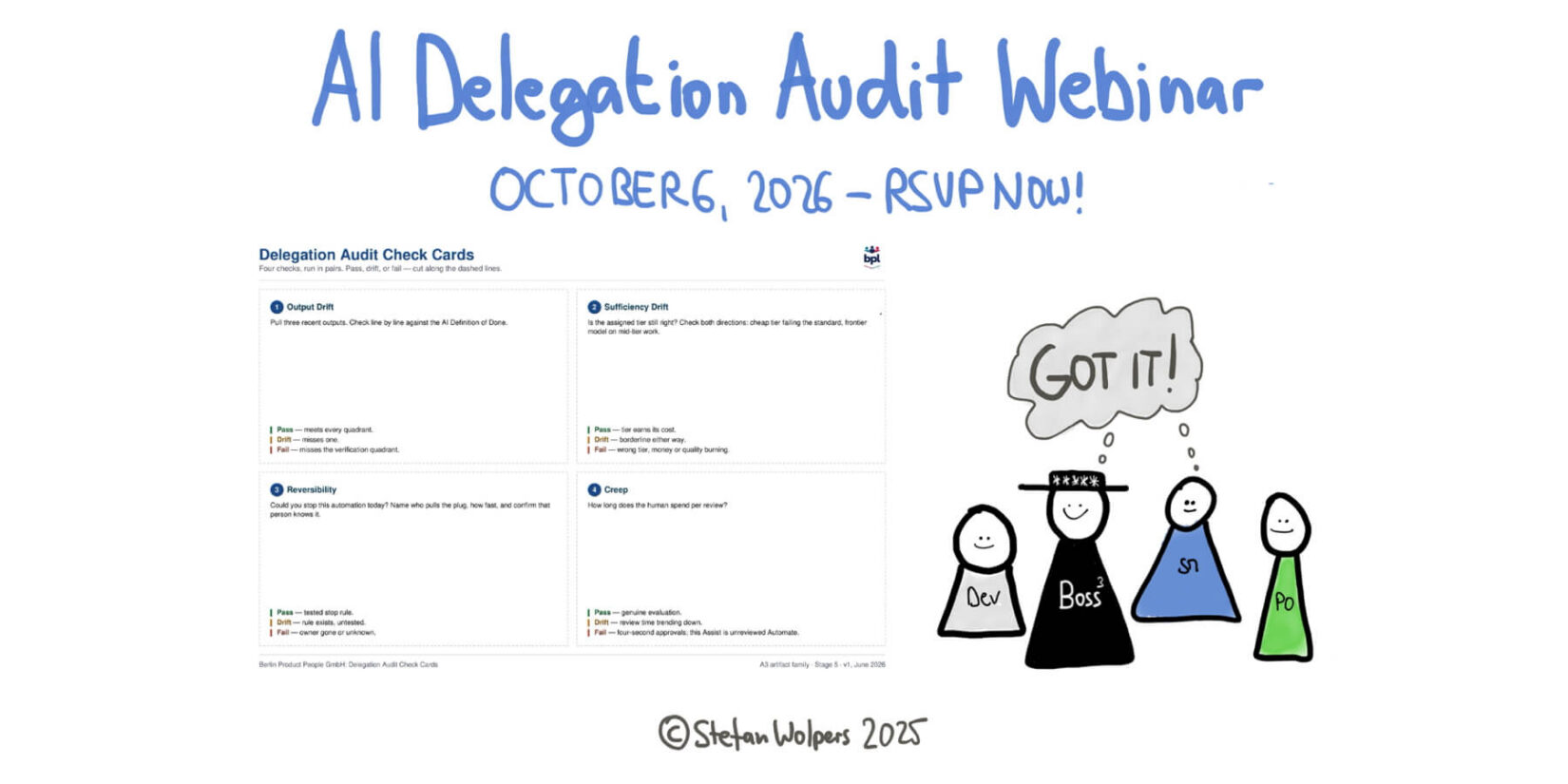
👉 RSVP now: The AI Delegation Audit – A Recurring Check for Work You’ve Handed to AI.
🛠 Concepts, Practices, Tools & Measuring
(via Medium): How to Turn a Book Into an AI Skill You Come Back To
Yanli Liu shows how to turn books and frameworks into reusable AI skills that surface knowledge during real work, replacing forgotten notes with practical, installable guidance your agent can load exactly when needed.
: Agentic Skill Decay: Mastery Still Comes From Doing the Reps
Addy Osmani warns that AI agents can complete work while eroding expertise, urging engineers to exercise judgment, form hypotheses, inspect outputs, ask why, and preserve repetition that builds real mastery.
: Experiment Canvas™: 5 Examples to Learn Fast & Kill Weak Bets
Braden Kelley suggests teams should structure experiments around falsifiable hypotheses, explicit kill criteria, and learning metrics, sequencing the riskiest questions first so that weak bets die before consuming serious money early on.
<!–
🎶 Encore
–>
📅 Scrum Training & Event Schedule
You can secure your seat for Scrum training classes, workshops, and meetups directly by following the corresponding link in the table below:
| Date | Class and Language | City | Price |
|---|---|---|---|
| 🖥 💯 🇬🇧 Sep 28-29, 2026 | GUARANTEED: A3 Delegation System Founding Workshop (English; Live Virtual Class) | Live Virtual Class | $199 incl. 19% VAT (If applicable.) |
| 🖥 🇩🇪 Sep 30-Oct 1, 2026 | Professional Scrum Product Owner Training (PSPO I; German; Live Virtual Class) | Live Virtual Class | €999 incl. 19% VAT (If applicable.) |
| 🖥 🇬🇧 October 15-November 5, 2026 | AI4Agile BootCamp #9 (English; Live Virtual Cohort) | Live Virtual Cohort | €499 incl. 19% VAT (If applicable.) |
See all upcoming classes here.

You can book your seat for the training directly by following the corresponding links to the ticket shop. If the procurement process of your organization requires a different purchasing process, please contact Berlin Product People GmbH directly.
📺 Join 6,000-plus Agile Peers on Youtube
Now available on the Age-of-Product YouTube channel to improve learning, for example, about the Hugging Face Controversy:
- Stop Writing Prompts. Let AI Do It for You — Hack #01, AI4Agile Online Course v2.
- Socratic Prompting — Hack #10, AI4Agile Online Course v2.
- Check Your AI’s Plan Before — Hack #7, AI4Agile Online Course v2.
- From Product Requirements to Experiments to Learnings — Supported by Generative AI.
- Never Accept an LLM’s First Offer — Improve GenAI’s Usefulness w/ Feedback Loops and Challenges.

✋ Do Not Miss Out: Learn more about the Hugging Face Controversy — Join the 20,000-plus Strong ‘Hands-on Agile’ Slack Community
I invite you to join the “Hands-on Agile” Slack Community and enjoy the benefits of a fast-growing, vibrant community of agile practitioners from around the world.

If you would like to join, all you have to do now is provide your credentials via this Google form, and I will sign you up. By the way, it’s free.
Help your team to learn about how AI Intensifies Work by pointing them to the free Scrum Anti-Patterns Guide:

🗞️ Last Week’s Food for Agile Thought Edition
The post Food for Agile Thought 560: The Hugging Face Controversy, Evals for Product Teams, Canvas for Experiments, Skill Decay appeared first on Age-of-Product.com.