TL; DR: AI Playbook, Product Taste — Food for Agile Thought #543
Welcome to the 543rd edition of the Food for Agile Thought newsletter, shared with 35,597 peers. This week, John Cutler warns in his AI Playbook that AI accelerates broken practices just as much as good ones, while Guy Champniss adds that the psychological toll of AI adoption on employee motivation may quietly erase the productivity gains organizations expect. Teresa Torres and Petra Wille challenge the rising “taste” narrative in product management, proposing that discovery skills and evidence beat gut feeling. David Pereira diagnoses why product management in Europe often underperforms, pointing to roadmap theater and consensus paralysis, and Laura Klein reminds us that involving engineers in research builds shared understanding faster than any handoff ever could.
Next, Andrej Karpathy describes how software development is shifting from vibe coding to agentic engineering, where judgment and architectural understanding matter more than writing code, and Cedric Chin offers three techniques for making sense of AI without losing your current frame. Also, Richard Kasperowski reminds us that CEOs never cared about Scrum, only results, and that AI raises the bar on engineering fundamentals. Paweł Huryn shows how Claude Design compresses product discovery from weeks to hours, and Wyndo and Dheeraj Sharma walk through building a competitor intelligence agent that develops editorial judgment over time.
Lastly, Jake Handy warns that executives mistake AI token consumption for productivity, while Paul LaPosta shows how AI-generated code inflates DORA metrics by boosting speed while eroding system understanding. Jack Clark raises the stakes further, estimating a 60%+ chance of fully automated AI R&D by 2028. Jim Lewis, Jeff Sauro, and colleagues find that AI usability evaluations catch only half the problems humans identify while generating unverified issues on top. Finally, Mike Fisher reminds us that belonging is not a soft perk but a measurable performance driver, built or destroyed one manager interaction at a time.
🎓 🇬🇧 The Claude Cowork Online Course — Available June 1-8 for $129
You have been prompting AI for months. The results are inconsistent, every conversation starts from zero, and the model forgets who you are. That is the ceiling of prompting.
The Claude Cowork Online Course teaches you to break through it: build Skills that encode your expertise, connect them to your tools, and assemble Agents who handle recurring work the way you would handle it yourself. No coding required.
What You Will Get:
✅ 8+ hours of self-paced video modules: Skills, Agents, delegation frameworks — ✅ Tested with a live BootCamp cohort (April 2026) — ✅ The A3 Framework: decide what to delegate and what to keep — ✅ Starter kit with folder structure, CLAUDE.md, and Skill templates — ✅ All texts, slides, prompts, graphics; you name it — ✅ Designed for the $20/month Pro plan — ✅ Lifetime access to the version you purchase — ✅ Claude Cowork Foundational Certificate.

👉 Please note: The course will be available for $129 from June 1 to 8, 2026! (After that, $199.) 👈
🎓 Join the Waitlist of the Course Now: Claude Cowork: Stop Prompting. Start Delegating. No Coding Required!
Did you miss the previous Food for Agile Thought issue 542?
🗞 Shall I notify you about articles like this one? Awesome! You can sign up here for the ‘Food for Agile Thought’ newsletter and join 35,000-plus subscribers.
🎓 Join Stefan in one of his upcoming Professional Scrum training classes!
🏆 The Tip of the Week
: The AI Playbook Puzzle
John Cutler suggests that AI supercharges good practices and accelerates bad ones, and that the real meta-skill now is reading context and challenging your own assumptions instead of following playbooks.
🎯 Product
and : Taste
Teresa Torres and Petra Wille question the hype around ‘taste’ as a product skill, suggesting it often masks personal preference as expertise. They propose investing in discovery skills and evidence over intuition.
: What I Learned From Building Competitor Intelligence Agent
Wyndo and Dheeraj Sharma describe building a competitor intelligence agent in Claude Cowork that retains memory across runs, compares weekly scans, and surfaces content gaps that compound over time into editorial judgment.
: 7 Reasons Why Product Is Damn Hard In Europe
David Pereira identifies seven reasons product management in Europe underperforms: roadmap theater, project over product thinking, consensus paralysis, risk aversion, process obsession, and job descriptions used as shields against change.
: From Weeks to Hours: How Claude Design Compresses Product Discovery
Paweł Huryn explores how Claude Design compresses product discovery by turning ideas into clickable prototypes in minutes, not days, and bridging the gap from approved design to shipped code without the usual Figma-to-engineering rebuild.
🧠 Artificial Intelligence
(via Harvard Business Review): The Psychological Costs of Adopting AI
Guy Champniss suggests that AI adoption’s negative psychological impact on employee motivation may cancel out the productivity gains companies are chasing, putting already questionable ROI models under even more pressure.
(via Sequoia Capital): 📺 From Vibe Coding to Agentic Engineering
Andrej Karpathy proposes that software development is shifting from vibe coding to agentic engineering, where the developer’s role moves from writing code to directing AI agents with judgment, taste, and architectural understanding.
(via Commonplace): How to Improve at Sensemaking AI?
Cedric Chin proposes three techniques for sensemaking AI: holding alternative frames without abandoning your current one, reading cues to detect hidden frames, and collecting fragments from past technological shifts for calibration.
: AI systems are about to start building themselves.
Jack Clark believes there is a 60%+ chance that fully automated AI R&D, where a model autonomously trains its own successor, will happen by the end of 2028, with profound implications for alignment, the economy, and society.
🖥 💯 🇬🇧 AI4Agile BootCamp #7, May 28 to June 25, 2026
The job market’s shifting. Agile roles are under pressure. AI tools are everywhere. But here’s the truth: the Agile pros who learn how to work with AI, not against it, will be the ones leading the next wave of high-impact teams.
So, become the one who professional recruiters call first for “AI‑powered Agile.” Be among the first to master practical AI applications for Scrum Masters, Agile Coaches, Product Owners, Product Managers, and Project Managers.
The class is in English. 🇬🇧
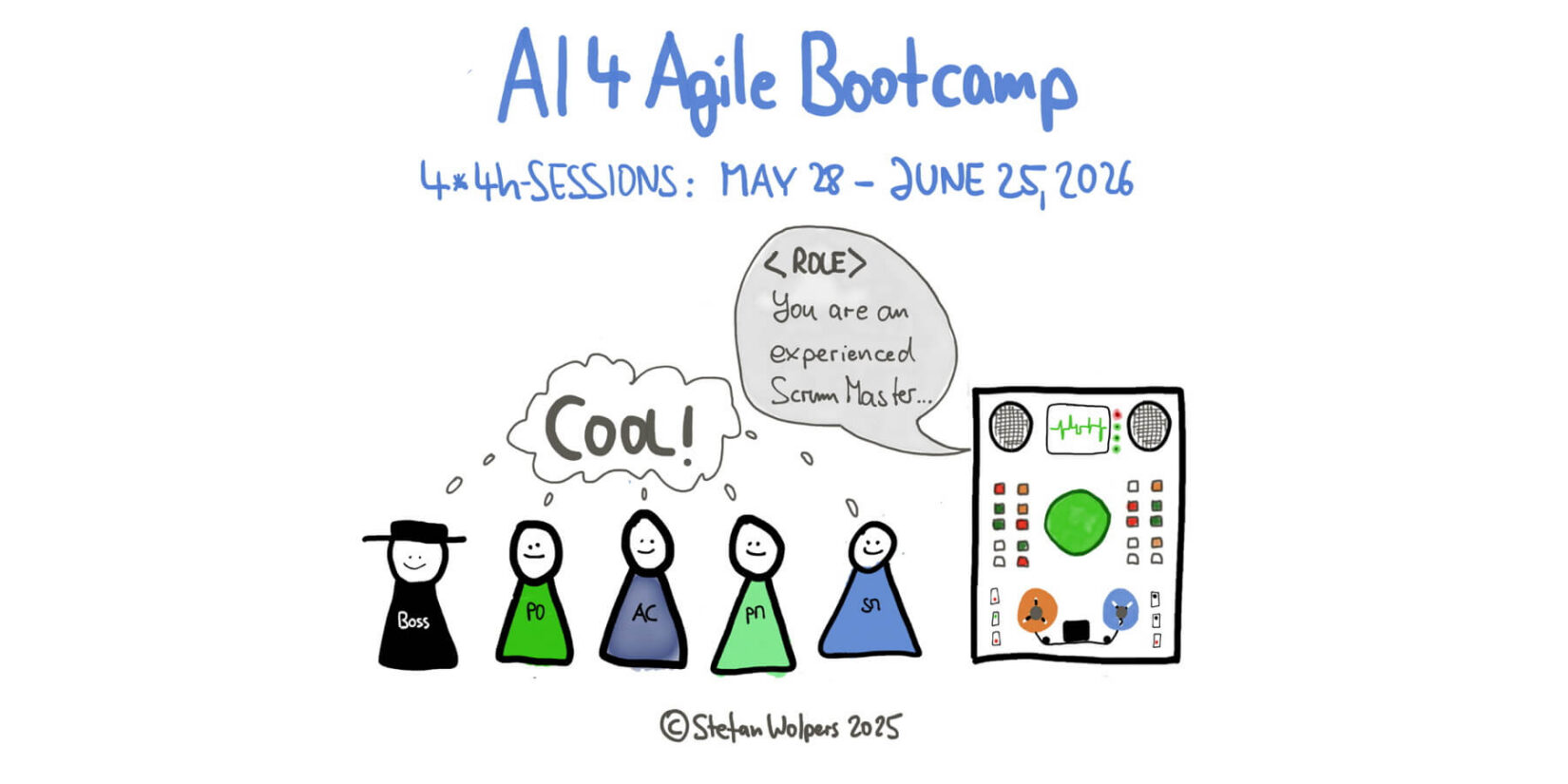
Learn more: 🖥 💯 🇬🇧 AI4Agile BootCamp #7, May 28 to June 25, 2026.
Customer Voice: “The AI for Agilists course is an absolute essential for anyone working in the field! If you want to keep up with the organizations and teams you support, this course will equip you with not only knowledge of how to leverage AI for your work as an Agilist but will also give you endless tips & tricks to get better results and outcomes. I thoroughly enjoyed the course content, structure, and activities. Working in teams to apply what we learned was the best part, as it led to great insights for how I could apply what I was learning. After the first day on the course, I already walked away with many things I could apply at work. I highly recommend this course to anyone looking to better understand AI in general, but more specifically, how to leverage AI for Agility.” (Lauren Tuffs, Change Leader | Business Agility.)
<!–
👉 From time to time, we can offer last-minute seats for training classes at cost to individuals who do not have access to a corporate training budget. If you would like to be notified about these opportunities, please register here.
–>
➿ Agile & Leadership
: Your CEO is suffering from AI psychosis
Jake Handy warns that executives are confusing AI token consumption with productivity, fueled by sycophantic models and flashy agent dashboards. His fix: write specs first, measure outcomes, and sleep eight hours.
: Scrum Doesn’t Matter (And It Never Did): Slides from my keynote at the Global Scrum Gathering. Vancouver, May 5, 2026
Richard Kasperowski, keynoting the Global Scrum Gathering 2026, uses his own production data to suggest that CEOs never cared about Scrum, only results, and that AI makes engineering fundamentals more important, not less.
: You Can’t Fake Belonging
Mike Fisher draws on veteran transition research and workplace data to suggest that belonging is not a soft perk but a measurable performance driver, built or destroyed by the immediate manager, one interaction at a time.
📯 The AI Spending Trap: Why Adoption Outpaces Outcomes
If you have spent the last twenty years arguing that velocity is not value, that adoption is not impact, that an Agile transformation is not a Jira migration, the Stanford AI Index 2026 will read like déjà vu: The technology is new. The failure mode, the AI spending trap, is not.
The 88 percent of organizations that have adopted AI but cannot show an EBIT impact are the same organizations that adopted Scrum without learning empiricism, adopted DevOps without changing how they fund teams, and adopted product management without giving anyone product authority.
The economic data is the evidence. The interpretation is what you already know.
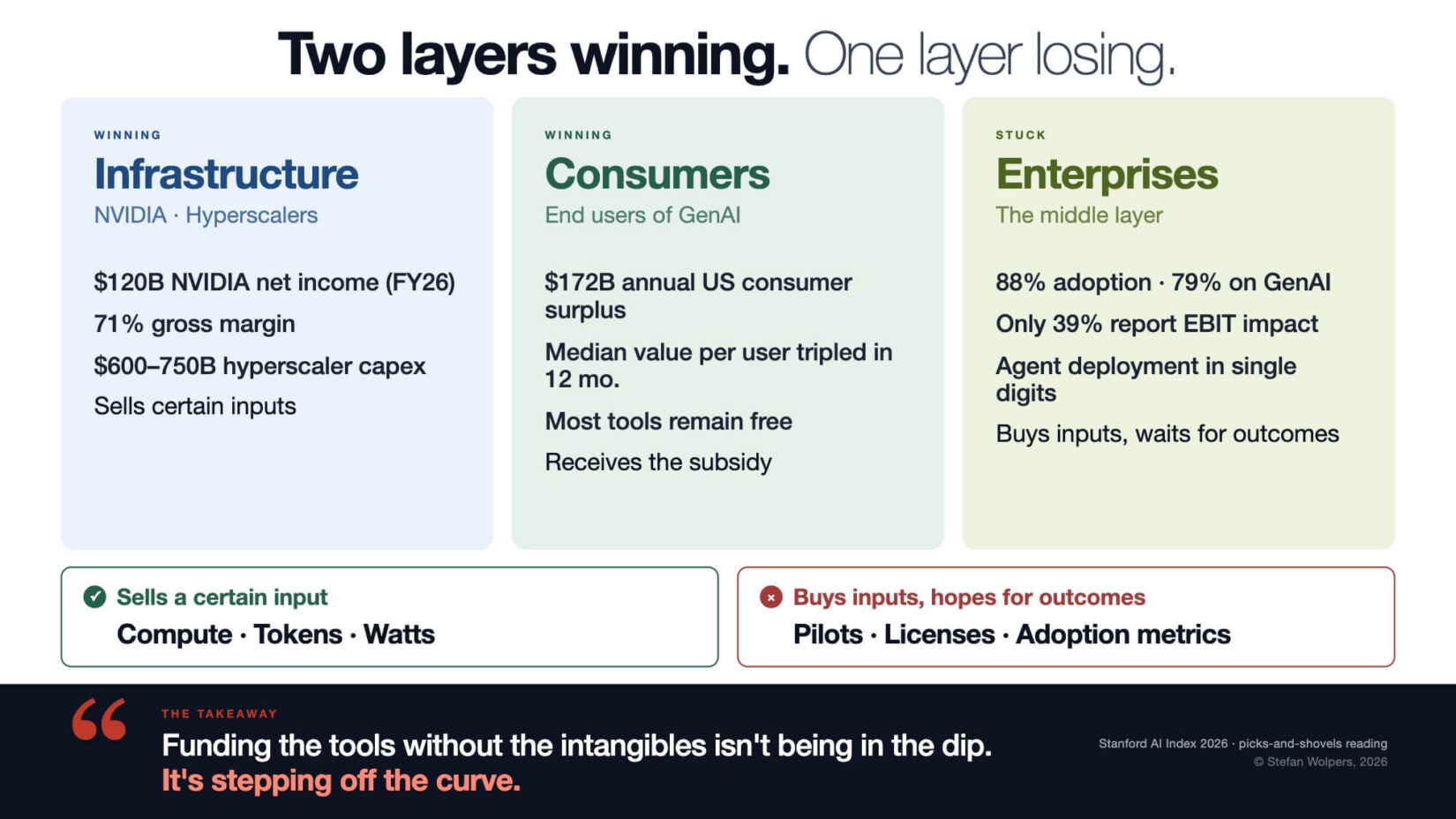
Learn more: The AI Spending Trap: Why Adoption Outpaces Outcomes.
🛠 Concepts, Practices, Tools & Measuring
(via IxDF – Interaction Design Foundation): Collaborating with Your Team for Research
Laura Klein proposes that cross-functional collaboration on research, especially involving engineers, builds deeper customer understanding across the team and surfaces technical issues early, even if some company cultures resist it.
(via Measuring Usability): Can AI Detect Usability Problems Like Researchers?
Jim Lewis, Jeff Sauro, and colleagues compared AI and human usability evaluations. They found that AI catches roughly half the problems researchers identify while generating even more unverified issues that still require human review.
(via LeadDev): DORA metrics are lying to you and AI is making it worse
Paul LaPosta proposes that AI-generated code inflates DORA metrics by boosting delivery speed while eroding system understanding, creating false confidence. He urges leaders to supplement DORA with scope notes, incident narratives, and legibility checks.
<!–
🎶 Encore
–>
📅 Scrum Training & Event Schedule
You can secure your seat for Scrum training classes, workshops, and meetups directly by following the corresponding link in the table below:
| Date | Class and Language | City | Price |
|---|---|---|---|
| 💯 🇩🇪 May 19-20, 2026 | Guaranteed: Professional Scrum Product Owner Training (PSPO I; German; Live Virtual Class) | Live Virtual Class | €1,299 incl. 19% VAT (If applicable.) |
| 💯 🇬🇧 May 28 to June 25, 2026 | Guaranteed: AI4Agile BootCamp #7 (English; Live Virtual Cohort) | Live Virtual Cohort | €499 incl. 19% VAT (If applicable.) |
| 🖥 💯 🇬🇧 June 1, 2026 | GUARANTEED: Claude Cowork: Stop Prompting. Start Delegating. (English; Self-paced Online Course) | Self-Paced Online Course | $129 incl. 19% VAT (If applicable.) |
| 🖥 💯 🇬🇧 June 10-July 2, 2026 | GUARANTEED: Claude Cowork BootCamp #2 (English; Live Virtual Cohort) | Live Virtual Cohort | $249 incl. 19% VAT (If applicable.) |
| 🇩🇪 June 30-July 1, 2026 | Professional Scrum Product Owner Training (PSPO I; German; Live Virtual Class) | Live Virtual Class | €1,299 incl. 19% VAT (If applicable.) |
| 🖥 💯 🇬🇧 July 1, 2026 | GUARANTEED: AI 4 Agile Course v3 — Master AI for Agile Practitioners (English; Self-paced Online Course) | Self-Paced Online Course | $149 incl. 19% VAT (If applicable.) |
See all upcoming classes here.

You can book your seat for the training directly by following the corresponding links to the ticket shop. If the procurement process of your organization requires a different purchasing process, please contact Berlin Product People GmbH directly.
📺 Join 6,000-plus Agile Peers on Youtube
Now available on the Age-of-Product YouTube channel to improve learning, for example, about the AI Playbook:
- Stop Writing Prompts. Let AI Do It for You — Hack #01, AI4Agile Online Course v2.
- Socratic Prompting — Hack #10, AI4Agile Online Course v2.
- Check Your AI’s Plan Before — Hack #7, AI4Agile Online Course v2.
- From Product Requirements to Experiments to Learnings — Supported by Generative AI.
- Never Accept an LLM’s First Offer — Improve GenAI’s Usefulness w/ Feedback Loops and Challenges.
✋ Do Not Miss Out: Learn more about the AI Playbook — Join the 20,000-plus Strong ‘Hands-on Agile’ Slack Community
I invite you to join the “Hands-on Agile” Slack Community and enjoy the benefits of a fast-growing, vibrant community of agile practitioners from around the world.

If you would like to join, all you have to do now is provide your credentials via this Google form, and I will sign you up. By the way, it’s free.
Help your team to learn about how AI Intensifies Work by pointing them to the free Scrum Anti-Patterns Guide:

🗞️ Last Week’s Food for Agile Thought Edition
The post Food for Agile Thought #543: AI Playbook, Product Taste, Competitor Intelligence Agent, CEO AI Psychosis appeared first on Age-of-Product.com.